Elon Musk’s Biggest Enemy in Court Is Elon Musk
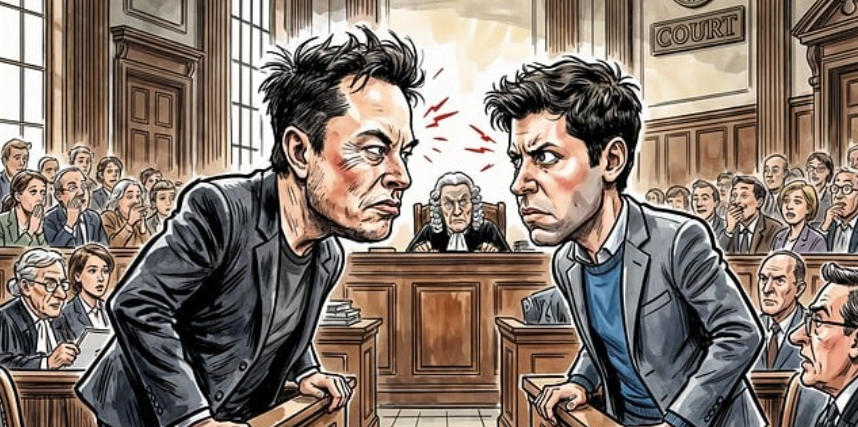
Elon Musk arrived in a federal courtroom in Oakland this week portraying himself as the last line of defense between humanity and runaway artificial intelligence.
By the end of his testimony, the defense had a different villain: Elon Musk’s own words.
In a high‑stakes trial that could reshape the future of OpenAI, Musk is suing the company’s leadership — CEO Sam Altman and co‑founder Greg Brockman — accusing them of abandoning OpenAI’s original nonprofit mission in favor of profits. Musk is demanding the reversal of OpenAI’s for‑profit structure and seeking up to $134 billion in damages, arguing that OpenAI’s transformation represents a betrayal of the organization’s founding charter.
“This is about stealing a charity,” Musk told the court. If such behavior were allowed, he argued, the very foundation of charitable giving in the U.S. would be destroyed.
But under intense cross‑examination, that narrative began to crack.
Attorneys for OpenAI presented internal emails and documents suggesting Musk himself supported — and at times actively pushed — for commercialization long before he publicly turned against it. According to court testimony and evidence, Musk explored multiple paths to consolidate power over OpenAI, including acquiring a majority ownership stake, installing loyal board members, or folding the AI lab directly into Tesla.
When those plans failed, OpenAI argues, Musk’s commitment did too.
The billionaire confirmed in court that he contributed roughly $38 million to OpenAI between 2015 and 2017. However, lawyers pointed out that Musk halted funding once his influence began to wane and OpenAI resisted his takeover ideas.
The courtroom exchanges grew increasingly tense. Presiding Judge Yvonne Gonzalez Rogers repeatedly intervened as Musk avoided giving clear yes‑or‑no answers, at one point comparing the defense’s questions to the loaded phrase, “Have you stopped beating your wife?” — a comment that prompted a sharp rebuke from the bench.
Perhaps the most damaging moments came when Musk was confronted with his own public statements.
Defense attorneys highlighted Musk’s recent posts on X claiming that Tesla would develop artificial general intelligence (AGI). Under oath, Musk contradicted those claims, testifying that Tesla is not currently pursuing AGI development. The discrepancy undercut his portrayal as a consistent, principled advocate for AI safety.
The contradictions extended beyond tweets. Evidence showed that after Musk exited OpenAI’s board in 2018, he went on to recruit key talent away from the organization — most notably Andrej Karpathy, a leading AI researcher — for his own ventures, including Tesla and later xAI, the OpenAI competitor Musk founded in 2023.
To OpenAI’s defense team, the pattern is clear: altruism when in control, outrage when excluded.
OpenAI denies ever promising to remain purely nonprofit, arguing that the shift toward a capped‑profit structure was necessary to fund large‑scale AI development. The company maintains that Musk was aware of these discussions from the start and only objected once OpenAI’s success placed it beyond his reach.
The trial, scheduled to last three to four weeks, could have far‑reaching consequences. A ruling against OpenAI may force structural changes, derail a potential IPO, and reshape how charitable trusts operate in the fast‑moving AI sector.
What’s unfolding in Oakland is more than a legal dispute. It’s a public reckoning over who gets to define the future of artificial intelligence — and whether moral language is being used to mask a very old struggle over power.
As The Verge and other outlets have noted, Musk’s courtroom performance suggests a paradox worthy of Silicon Valley itself: the man warning about humanity’s greatest technological risks may be losing his case to the most familiar adversary of all — himself.