Beyond 320 kgf - T-MOTOR Introduces the SUPER-E Series for eVTOL & Heavy Logistics
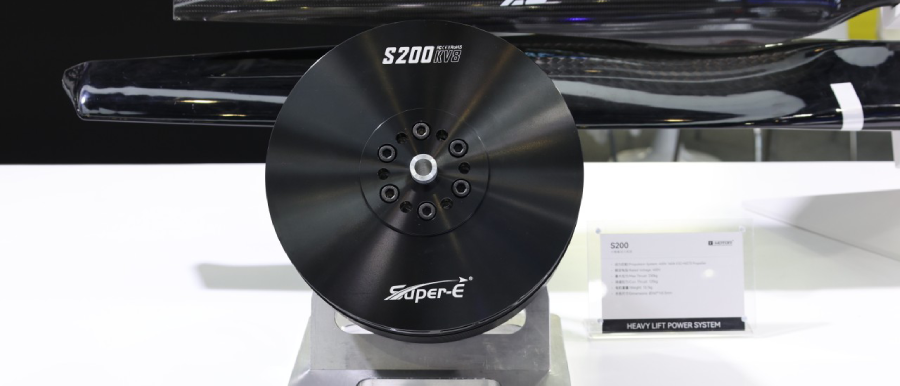
The global drone industry is entering a phase where propulsion systems define what is possible. As payload demands rise across logistics, inspection, agriculture, emergency support and urban air mobility, electric motors are being pushed far beyond hobby-grade performance. In this race, T-MOTOR has launched the SUPER-E series, a new line of high-power propulsion systems engineered for platforms where every kilogram of lift matters.
Designed for industrial aerial vehicles, cargo drones, eVTOL aircraft and next-generation UAM concepts, the SUPER-E motors bring not just raw thrust, but a focus on efficiency and reliability under continuous load — a crucial factor for commercial operations.
Four Models — One Goal: Heavy-Lift Performance
The series spans four thrust classes, scaling from 100 kgf to an impressive 320 kgf per motor:
- Maximaler Schub: 100 kgf
- Dauerhaft möglicher Schub: 50 kgf
- Maximaler Schub: 165 kgf
- Dauerhaft möglicher Schub: 90 kgf
- Maximaler Schub: 230 kgf
- Dauerhaft möglicher Schub: 120 kgf
- Maximaler Schub: 320 kgf
- Dauerhaft möglicher Schub: 160 kgf
The flagship S320 breaks through the 300 kgf threshold — a value once associated only with hybrid or combustion drive systems. Yet within the lineup, it is the S150 that T-MOTOR highlights as the most versatile and widely applicable model.
Spotlight on the S150: Performance Meets Practicality
The S150 delivers 42 kW peak power, runs on high-voltage 400 V architecture, and weighs only 9.1 kg. With up to 165 kg max thrust and more than 90 kg continuous thrust, one motor alone can support meaningful payload configurations. In hexacopter or octocopter arrangements, this opens pathways to:
- mid-range industrial cargo aircraft
- environmental monitoring and emergency drop systems
- offshore energy inspection drones
- agricultural distribution platforms
- eVTOL prototypes and research craft
High-voltage operation means thinner cables, reduced resistive losses, and improved energy efficiency — all key to extending flight time and increasing payload margins.
Engineering for Endurance, Not Just Peak Numbers
High thrust is only useful if a motor can sustain it. For this reason, the SUPER-E line invests heavily in thermal design and structural reinforcement.
Heat Management:
The heat dissipation area is 3–4× greater than in traditional solutions. Combined with optimized airflow channels and optional liquid-cooling support, the system maintains safe temperatures under demanding duty cycles.
Durability and Load Capacity:
New bearing architecture increases axial load limit by ~2.5×, enabling safer operation in heavy multirotor and eVTOL layouts where vertical force is constant. This is essential for flight stability, especially when carrying large cargo or passenger modules.
Structural Innovation:
Internal geometry and material choices reduce vibration and wear, further supporting long operational lifetimes — a crucial requirement for commercial fleets.
High-Voltage Future of UAM Propulsion
With 100–320 kgf thrust brackets, the SUPER-E range positions itself as a core propulsion candidate for:
- cargo drones up to hundreds of kilograms
- passenger eVTOL demonstrators
- hybrid-electric aircraft
- long-endurance logistics networks
Customization options remain available for specific voltage, cooling, and integration requirements — suggesting that T-MOTOR is preparing for a market where standardized modules meet tailored airframes.
As the industry pushes toward scalable air logistics, power systems like SUPER-E may become foundational. In an era defined by endurance, reliability, and heavy lift, 320 kgf is not the end — only the beginning.
.png)
.jpg)