A Billion-Dollar Drone, a Public Beach, and Reddit. The Accidental Leak That Exposed Britain's Next Air Defense Weapon
Defense companies spend millions protecting secrets.
Engineers lock away prototypes behind fences, security clearances, and non-disclosure agreements. Investors hear carefully scripted presentations. Competitors search desperately for clues.
And then sometimes, a prototype washes up on a public beach.
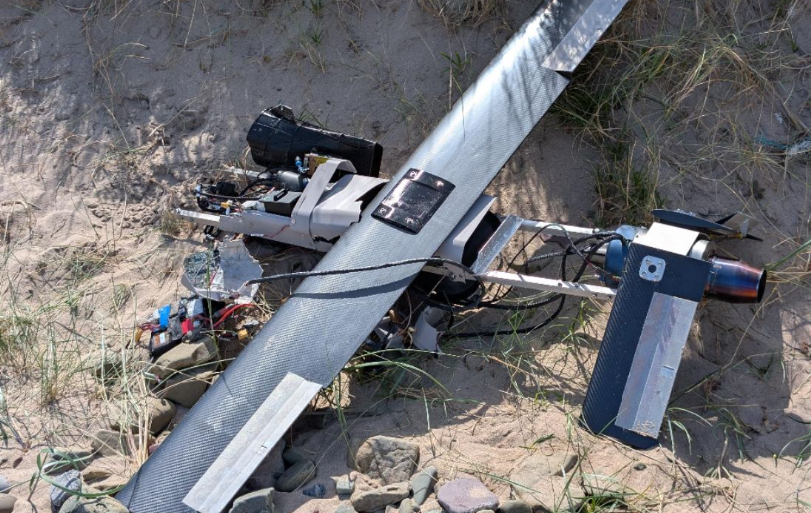
That appears to be exactly what happened when a Cambridge Aerospace "Skyhammer" drone interceptor reportedly crashed on the British coastline, was recovered by a member of the public, and eventually found its way onto Reddit.
For military analysts and defense enthusiasts, it was the modern equivalent of finding a classified blueprint floating in a bottle.
The timing could hardly be more intriguing.
Cambridge Aerospace has emerged as one of Britain's most talked-about defense start-ups, reportedly pursuing a funding round valuing the company in the billions of dollars. Yet despite the attention, remarkably little technical information has entered the public domain regarding Skyhammer, a system designed to intercept increasingly dangerous drone threats.
Until now.
The images offer a rare glimpse into how a new generation of defense companies is approaching one of the defining military challenges of the 21st century: how to stop cheap drones without spending millions of pounds doing it.
The most striking feature is the propulsion system.
At first glance, the aircraft appears powered by a small jet turbine, likely from German manufacturer JetCat. These miniature engines have become increasingly popular across advanced unmanned systems, providing high speed, compact dimensions, and relatively straightforward integration.
The choice says a great deal about the intended mission.
Unlike slower propeller-driven interceptors designed for endurance, a turbine-powered platform prioritizes speed.
That makes sense in a world where the targets are increasingly fast-moving one-way attack drones, cruise missiles, and sophisticated aerial threats.
The interceptor itself appears surprisingly simple.
In an era when defense brochures are filled with buzzwords such as artificial intelligence, autonomous swarms, and revolutionary technologies, the visible construction hints at a more pragmatic philosophy.
The internal structure appears built around straightforward aluminum sections. The outer shell shows signs typically associated with additive manufacturing. The wings appear conventional rather than exotic.
To some observers, that might look unsophisticated.
In reality, it may be exactly the opposite.
The war in Ukraine has transformed military thinking. Designers have learned that affordability often matters more than perfection. The battlefield is consuming drones at extraordinary rates. Systems that are expensive, difficult to manufacture, or impossible to scale quickly become liabilities.
The most successful military technologies are increasingly those that can be produced rapidly and in large numbers.
Speed of production is becoming as important as speed in the air.
The apparent simplicity of Skyhammer suggests engineers may be embracing that reality.
Another notable feature is what appears to be a deliberate focus on mission optimization.
By positioning the turbine at the rear, engineers free valuable internal volume for fuel, guidance electronics, datalinks, sensors, and potentially a payload designed to neutralize hostile drones.
Every cubic centimeter matters in an interceptor.
Weight, range, speed, and lethality constantly compete against each other.
Design is compromise.
The crash also provides insight into an uncomfortable truth often forgotten during defense marketing campaigns.
Building a successful drone is hard.
Building a successful interceptor is even harder.
An aircraft must launch reliably, navigate autonomously, track a maneuvering target, survive electronic warfare, avoid obstacles, and then successfully intercept its objective in seconds.
Failures are not signs of weakness.
They are signs of development.
Nearly every successful aerospace program in history has left behind a trail of crashed prototypes.
The broader significance extends far beyond one damaged aircraft.
The global counter-drone market is exploding as militaries confront a battlefield where cheap unmanned systems increasingly threaten expensive platforms, infrastructure, and personnel.
Traditional air-defense economics are breaking down.
Using million-dollar missiles to destroy drones costing a few thousand dollars is unsustainable.
A new generation of specialized interceptors is emerging to solve that equation.
Skyhammer appears to be part of that revolution.
Whether this particular aircraft represents an early prototype, a test article, or something closer to an operational configuration remains unknown.
But one thing is clear.
What began as debris discovered on a beach has become an unexpected window into one of defense technology's most competitive races.
In an age of secrecy, sometimes the biggest revelations arrive by accident.
And sometimes they arrive washed ashore.