SWARM Biotactics - When Robotics Starts to Use Biology And The Programmable Cyborg Insect Army That Could Redefine Robotics
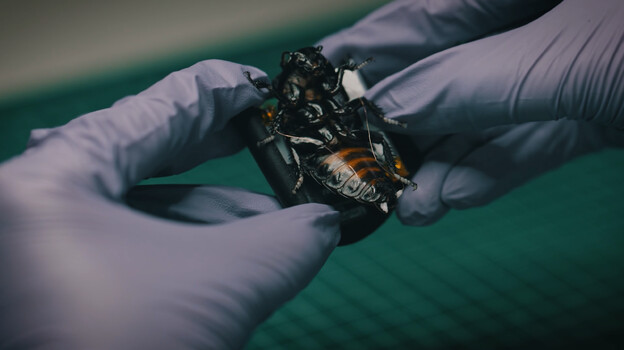
The SWARM BioSwarm system developed by SWARM Biotactics introduces a radical new concept in robotics: programmable insect swarms that combine biological mobility with artificial intelligence.
Instead of building fleets of tiny robots in factories, the company equips living insects with ultra-light electronic payloads that transform them into autonomous sensing platforms.
The result is a new category of technology sometimes described as biohybrid robotics—where machines and living organisms operate together as integrated systems.
In SWARM Biotactics’ vision, insects become biological micro-drones, capable of navigating environments that traditional robots struggle to access.
Turning Insects into Cyborg Platforms
The SWARM BioSwarm platform relies on miniature hardware modules attached to insects. These payloads can include:
- environmental sensors
- bioelectronic locomotion interfaces
- secure communication systems
- edge AI processing units
Together, these components allow insects to function as part of a coordinated robotic network.
The bioelectronic interface can influence the insect’s movement, enabling software systems to guide locomotion and navigation. Meanwhile, onboard sensors collect data and transmit it through secure communication channels.
The insects themselves provide something difficult to replicate with conventional robotics: extremely efficient mobility at microscopic scale.
Swarm Intelligence in Action
One of the most powerful aspects of the system is swarm coordination.
Rather than controlling individual insects manually, SWARM Biotactics uses algorithms that guide large numbers of insects simultaneously. This creates a collective sensing network, where hundreds or potentially thousands of units can explore an environment.
Such swarms could move autonomously through complex spaces such as collapsed buildings, industrial infrastructure, or natural terrain.
The swarm architecture allows data gathered by individual units to contribute to a shared situational picture, enabling distributed sensing and monitoring.
Scaling Through Biology
Traditional robotics faces a major scaling challenge.
Manufacturing thousands or millions of small robots requires extensive production capacity, supply chains, and maintenance infrastructure.
SWARM Biotactics approaches the problem differently.
Instead of manufacturing robotic bodies, the system leverages biological reproduction and natural mobility.
Insects can be bred in large numbers, meaning swarm size can scale rapidly without traditional manufacturing bottlenecks.
The technology therefore represents a form of physical AI beyond conventional robotics, where software and electronics augment biological systems rather than replacing them.
Low-Signature and High-Density Deployment
Another advantage of biohybrid swarms is their extremely low physical signature.
Tiny insects are naturally quiet, energy-efficient, and capable of operating in environments where mechanical drones might attract attention or struggle to maneuver.
This makes the technology particularly interesting for applications requiring:
- discreet sensing
- distributed monitoring
- access to confined spaces
- operations in complex natural environments
By combining biological mobility with digital communication and AI processing, the system effectively turns natural organisms into nodes within a larger sensing network.
Early Defense and Security Applications
SWARM Biotactics has already begun working with defense and security customers, signaling that interest in biohybrid robotics is moving from research concepts toward operational testing.
For defense organizations, swarms of autonomous sensing units could support tasks such as:
- environmental reconnaissance
- infrastructure monitoring
- search and rescue operations
- situational awareness in complex terrain
Because the units are small, numerous, and distributed, they could create high-density sensor networks that are difficult to disrupt.
A New Frontier for Robotics
The emergence of technologies like SWARM BioSwarm suggests that the future of robotics may not be limited to metal machines and silicon chips.
Instead, the next generation of robotic systems could integrate biology, electronics, and artificial intelligence into entirely new forms of technology.
Biohybrid robotics challenges traditional assumptions about what a robot actually is.
If machines can guide and network biological organisms into coordinated systems, robotics may evolve into something far more complex than mechanical devices alone.
And in that future, the smallest members of the animal kingdom could become part of the most advanced technological networks ever created.